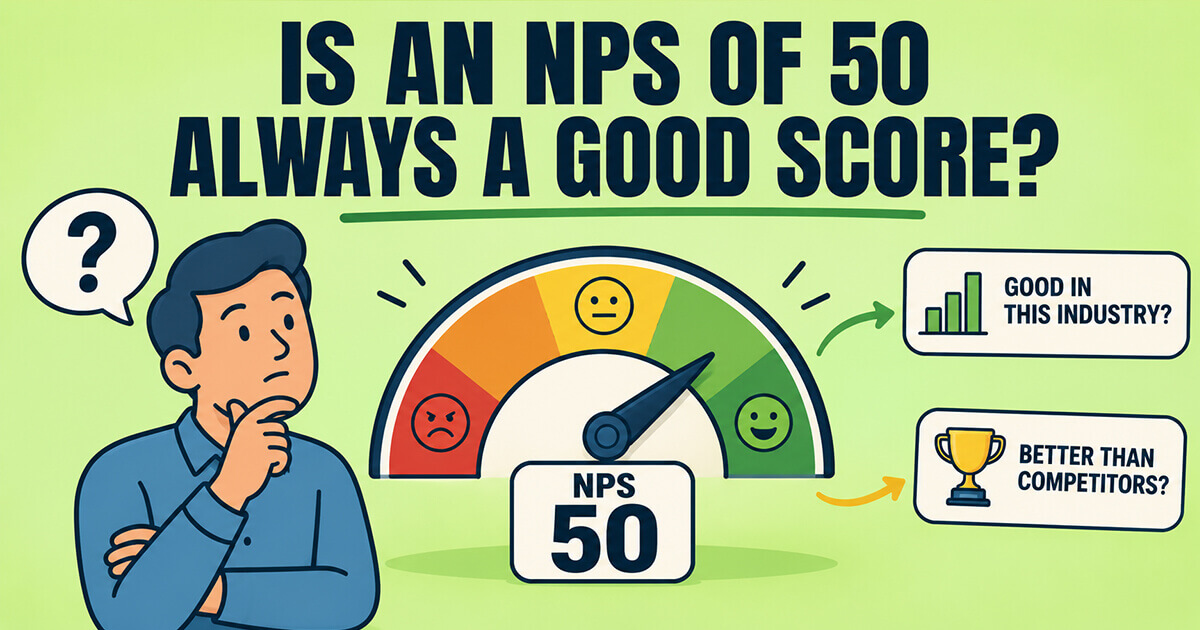
An NPS of 50 has a strong reputation—and for good reason.
In many sectors, it reflects a customer base with far more promoters than detractors. On paper, that's an excellent outcome.
The problem is that NPS isn't a universal grading system. A score only becomes meaningful when you know what you're comparing it to.
A score of 50 is usually strong...
Net Promoter Score ranges from -100 to +100.
Anything above zero means promoters outnumber detractors. Scores above 30 are often considered healthy, while scores above 50 are generally associated with high levels of customer loyalty.
If your business reaches that threshold, it's a sign that many customers are willing to recommend you.
But that's only the starting point.
...but it may not be exceptional
Imagine two companies with the same NPS of 50.
The first operates in an industry where the average score is around 20. It's clearly outperforming its peers.
The second competes in a sector where leading brands regularly achieve scores above 65. In that context, 50 is respectable—but no longer exceptional.
The number hasn't changed. The benchmark has.
That's why comparing NPS across unrelated industries often leads to the wrong conclusions.
Trends matter as much as benchmarks
A single survey captures a moment in time.
Looking at how your score evolves tells a much richer story.
An increase from 28 to 42 suggests customers are noticing meaningful improvements. A decline from 62 to 50 deserves attention, even though the latest score still looks impressive.
When evaluating NPS, direction is often more informative than the absolute value.
The reasons behind the score matter even more
NPS measures customer sentiment. It doesn't explain it.
The comments collected alongside the score reveal what's driving loyalty—or frustration.
Recurring themes around support, pricing, product quality, or delivery are usually more actionable than the score itself. They tell you where to focus improvement efforts.
Ask better questions
Instead of asking whether an NPS of 50 is good, consider asking:
- Is it above or below our industry's benchmark?
- Has it improved over the past year?
- Are competitors moving faster?
- What do customer comments consistently highlight?
- Which operational changes influenced the result?
These questions turn a score into a business decision.
Final Word
An NPS of 50 is often a sign that customers value what you deliver.
Whether it's a good score depends on the context.
Industry benchmarks, historical trends, and customer feedback all provide essential perspective. Without that context, even an excellent-looking NPS can be misleading.
That's why, at NPSBench, we believe benchmarking matters just as much as measurement. A score becomes truly useful when you know what it means relative to your market—not just relative to zero.