There's no recommended NPS schedule that works for every business.
Some companies survey customers every quarter. Others measure loyalty once a year, while many collect feedback after specific interactions. None of these approaches is inherently right or wrong. What matters is whether the survey cadence reflects how customers experience your business.
The objective isn't to collect more responses. It's to collect feedback at the right time and often enough to spot meaningful trends.
Start with your customer journey
Before deciding how frequently to run an NPS survey, consider a few practical questions:
- How often do customers interact with your business?
- How long does a typical customer relationship last?
- How quickly does your product or service change?
- How often can you realistically act on the feedback?
Businesses with long sales cycles and multi-year customer relationships don't need the same measurement rhythm as companies serving thousands of customers every day.
Relationship NPS and transactional NPS serve different purposes
Survey frequency also depends on the type of NPS you're collecting.
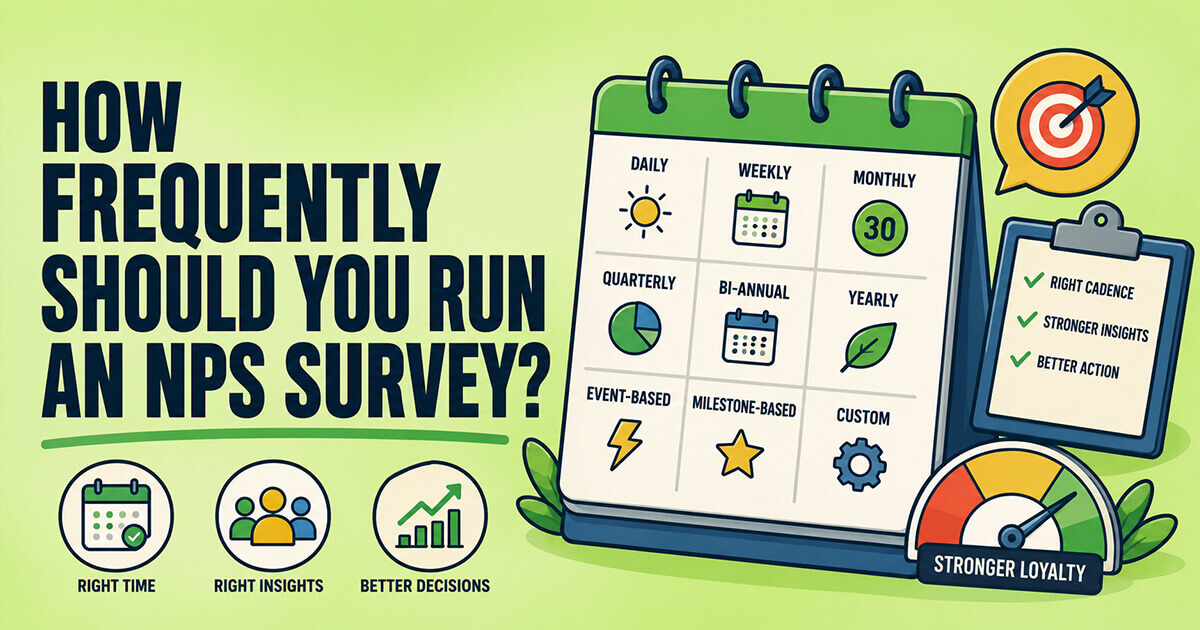
A relationship NPS measures overall customer loyalty. It's typically sent on a recurring schedule—every quarter, every six months, or once a year—to monitor long-term sentiment.
A transactional NPS follows a specific interaction, such as a purchase, support case, onboarding, or product delivery. Its goal is to evaluate a recent experience while it's still fresh.
Many organizations combine both. One tracks the health of the relationship, while the other helps identify operational issues.
Typical survey cadences
Although every organization is different, some patterns emerge.
SaaS and subscription businesses
Quarterly or twice-yearly relationship surveys are common. Transactional surveys can complement them after onboarding or major customer milestones.
E-commerce
Relationship NPS is often measured once or twice a year. Transactional surveys work well after an order has been delivered, but they shouldn't be triggered after every purchase.
B2B services
Quarterly or semi-annual surveys generally provide enough visibility. For project-based businesses, collecting feedback at key milestones often produces more useful insights than relying on fixed dates.
Retail and hospitality
Because customer interactions are frequent, event-based surveys tend to be more relevant than scheduled campaigns. The main challenge is avoiding repeated requests to the same customers.
Survey fatigue is real
It's tempting to believe that more surveys lead to better insights.
In practice, the opposite can happen.
Customers who receive frequent survey requests are less likely to respond, and those who do may provide less thoughtful feedback. Over time, response rates decline, making the data less representative.
Protecting the customer experience should remain part of any NPS strategy.
Measuring too infrequently has its own cost
At the other extreme, surveying once a year may not be enough to detect meaningful changes.
Customer expectations evolve continuously. Product updates, pricing changes, service issues, or new competitors can all affect customer loyalty long before the next annual survey.
Regular measurement makes it easier to identify trends early, rather than reacting months later.
Focus on consistency
The most effective NPS programs aren't necessarily the ones that measure most often.
They're the ones that measure consistently.
Choose a cadence that matches your business, avoid repeatedly surveying the same customers, and make sure feedback leads to action. Over time, a stable methodology will provide more valuable insights than constantly changing your survey schedule.
Final Word
The right NPS frequency isn't defined by a calendar. It's defined by your customers.
Measure often enough to understand how loyalty evolves, but not so often that surveys become background noise. A consistent approach, paired with meaningful follow-up, will produce insights that are both more reliable and more useful.