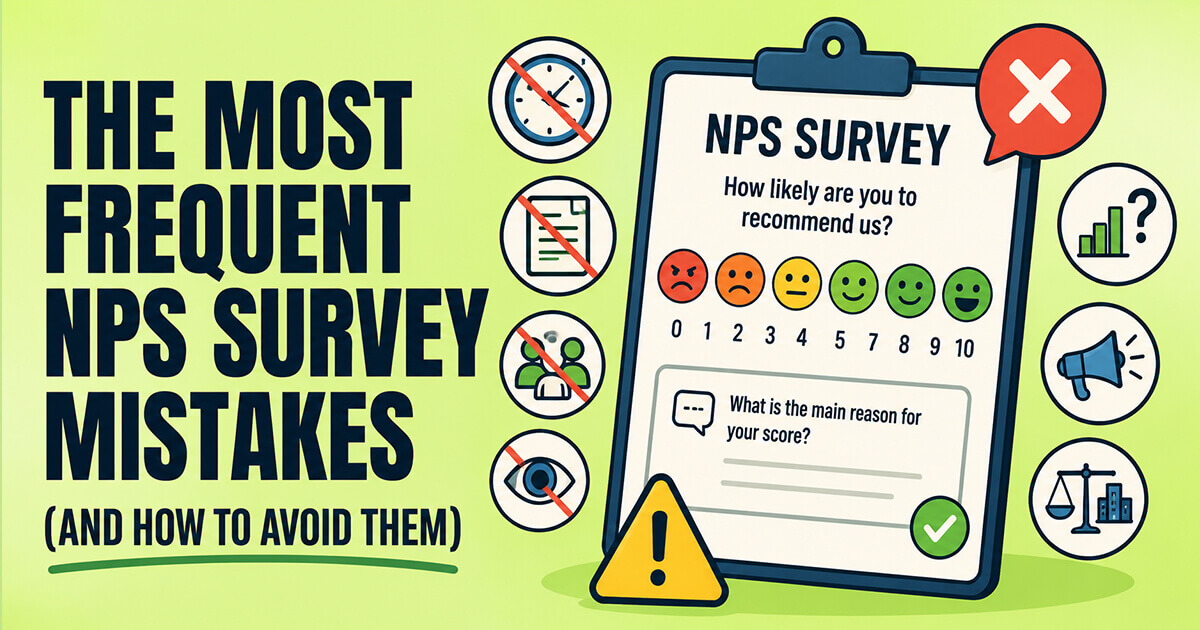
Collecting an NPS is straightforward. Collecting one you can trust is another matter.
Small decisions, when you send the survey, who receives it, or how you interpret the responses, can significantly influence the final score. In many cases, the issue isn't the NPS methodology itself but the way it's implemented.
Here are the mistakes that most often reduce the value of an NPS survey.
Mistake #1. Surveying customers at the wrong stage
Customer sentiment changes throughout the journey.
Ask for feedback before customers have experienced your product, and they'll have little to evaluate. Ask after a frustrating support interaction, and the score may reflect that isolated event rather than the overall relationship.
Instead of chasing the "perfect" moment, establish a consistent trigger that aligns with a meaningful customer milestone.
Mistake #2. Turning a short survey into a long questionnaire
The strength of NPS lies in its simplicity.
Adding page after page of follow-up questions increases abandonment rates and often leads to lower-quality responses.
A single open-ended question explaining the score usually delivers the most valuable insight. If deeper research is needed, run a dedicated survey rather than expanding your NPS questionnaire.
Mistake #3. Measuring only your best customers
A surprisingly common mistake is surveying only customers who are likely to leave positive feedback.
Whether intentional or not, excluding inactive users, recent complaints, or churn risks creates an overly optimistic picture.
An NPS should reflect your customer base—not your most satisfied segment.
Mistake #4. Looking only at the score
Two companies can report the same NPS while facing very different customer issues.
The score tells you what happened. Customer comments often explain why.
Reading qualitative feedback alongside the metric is where most of the value lies.
Mistake #5. Ignoring response rates
An impressive NPS deserves a second look if very few customers responded.
Participation levels provide important context. If only a small fraction of customers completed the survey, it's difficult to know whether the results represent the broader customer population.
Tracking response rates over time helps identify changes in survey quality as well as customer engagement.
Mistake #6. Collecting feedback without acting on it
Customers quickly notice when surveys lead nowhere.
Closing the feedback loop—whether by contacting detractors, sharing findings internally, or implementing recurring suggestions—makes the survey more than a reporting exercise.
An effective NPS program creates operational improvements, not just monthly dashboards.
Mistake #7. Comparing irrelevant benchmarks
An NPS of 40 can be outstanding in one industry and disappointing in another.
Meaningful benchmarking requires comparable companies, similar customer expectations, and, ideally, the same geographic market.
Without context, even accurate scores can be misleading.
Better surveys produce better decisions
Reliable NPS programs share a few characteristics:
- They survey customers consistently.
- They keep questionnaires concise.
- They use representative samples.
- They monitor response rates.
- They analyze customer comments.
- They act on recurring feedback.
- They benchmark against relevant peers.
None of these practices changes the NPS formula. They simply make the result more trustworthy.
Final Word
An NPS survey is a measurement tool, not an objective in itself.
The quality of the insight depends less on the question than on the process behind it. Organizations that pay attention to sampling, timing, and follow-up are more likely to produce scores they can confidently use to guide business decisions.